The problem

Field operations lose capacity in predictable places.

None of these are failures of effort. They are structural consequences of how work is allocated and sequenced.

Travel
Time spent moving between geographically unrelated instructions.
Poor geographic sequencing
Daily allocations that criss-cross an area rather than working through it.
Plant idle time
Specialist equipment standing while the crew waits or travels.
Unnecessary mobilisation
Repeated set-up and break-down for isolated defects in the same locality.
Administrative duplication
The same information recorded more than once, in more than one place.
Inappropriate working windows
Work programmed into periods when traffic conditions restrict productivity.
Fragmented work allocation
Job-by-job instruction that removes any opportunity to optimise across the whole.

The design objective

Designed around a small number of measures.

Stonegate Infrastructure is built to maximise these specifically, because they are what a client is actually buying.

Together they describe best value in practical terms. Highways budgets are public money and must demonstrate measurable value, so the objective is to increase the useful maintenance output achieved from the expenditure available — not simply to hold the lowest rate on a schedule.

A highways operative reviewing an optimised daily work programme on a rugged tablet mounted in a vehicle cab.
Daily programme review before mobilisation.
Accepted repair output per shift
Completed, quality-accepted interventions — not activity.
Productive plant utilisation
The proportion of the working period during which plant is repairing rather than travelling or standing.
Cost per accepted repair
Cost measured against delivered, accepted output rather than against time on site.
Cost per m²
A comparable basis for area treatments, so patching can be assessed against the alternatives.
Right first time
Accepted repairs that do not require unnecessary repeat visits to the same location.
Programme visibility
Clear, current reporting of what has been completed and what remains.

We do not publish target figures against these measures. Any numbers offered now would be projections rather than performance. Baselines and targets are established with the client at the start of a programme, and reported against thereafter.

Commercial model

Where the client's control ends and ours begins.

This division matters, and we want to be precise about it. It is not a request for the client to hand over control of their network.

Intervention levels, inspection regimes and defect categories are set by the highway authority under its own risk-based maintenance policy, consistent with the UK Roads Liaison Group code of practice for well-managed highway infrastructure. Nothing in this model changes that.

The client remains responsible for

  • Setting intervention levels and determining which defects require repair
  • Setting the required standards and specifications
  • Defining service levels, categories and response requirements
  • Inspection, categorisation and statutory duties
  • Approving the works pool released to us
  • Acceptance of completed work

Stonegate Infrastructure is responsible for

  • Delivering the agreed pool within contractual constraints
  • Routing, sequencing and geographic clustering
  • Crew and plant allocation across the programme
  • Selecting working windows within permitted arrangements
  • Safe systems of work and temporary traffic management
  • Evidence capture and programme reporting

Where the commercial model permits, Stonegate Infrastructure takes ownership of delivering the agreed programme within the scope, standards and service levels the client sets — rather than supplying labour and plant to be directed job by job. Programme level allocation allows delivery to be optimised far more effectively than isolated daily job assignment.

Where it does not, we work within whatever allocation model the contract specifies. The optimisation described here is an opportunity to be discussed, not a precondition of engagement.

Worked example

From a works pool to daily programmes.

An illustration of how a released pool of approved defects becomes a sequence of deliverable working days.

The figure below is used to illustrate the method. It is not a description of a contract held or work completed.

500 approved defects released as a single programme

  1. Approved defect pool Client-defined
  2. Geographic clustering Density
  3. Traffic and access constraints applied Feasibility
  4. Crew and plant allocation Resource
  5. Optimised daily programmes Sequence
  6. Completed, evidenced repairs Output
Each stage narrows the options: clustering creates density, constraints remove sequences that cannot be delivered, and resource allocation resolves the remainder into a set of deliverable daily programmes.

Continual improvement

Each programme should inform the next.

Programme data is only worth capturing if it changes how the following programme is planned.

The records produced during delivery describe where the working period actually went. Reviewed across a programme rather than a single day, they identify:

  • Productive hours per shift
  • Travel time and distance losses
  • Intervention duration by method
  • Material usage against work delivered
  • Repeat repairs at treated locations
  • Plant idle time
  • Geographic density achieved
  • Working window performance

The output of that review is practical: a revised approach to clustering, sequencing, crew allocation or working windows for the next release of work. It is operational learning rather than analysis for its own sake.

On innovation. We apply technology where it improves the physical delivery outcome — how work is allocated and routed, how plant is utilised, how evidence is captured and how quality is assured. Software that does not change what happens on the carriageway is administration, not innovation, and we do not present it as such.

Working windows

The right hours for the road.

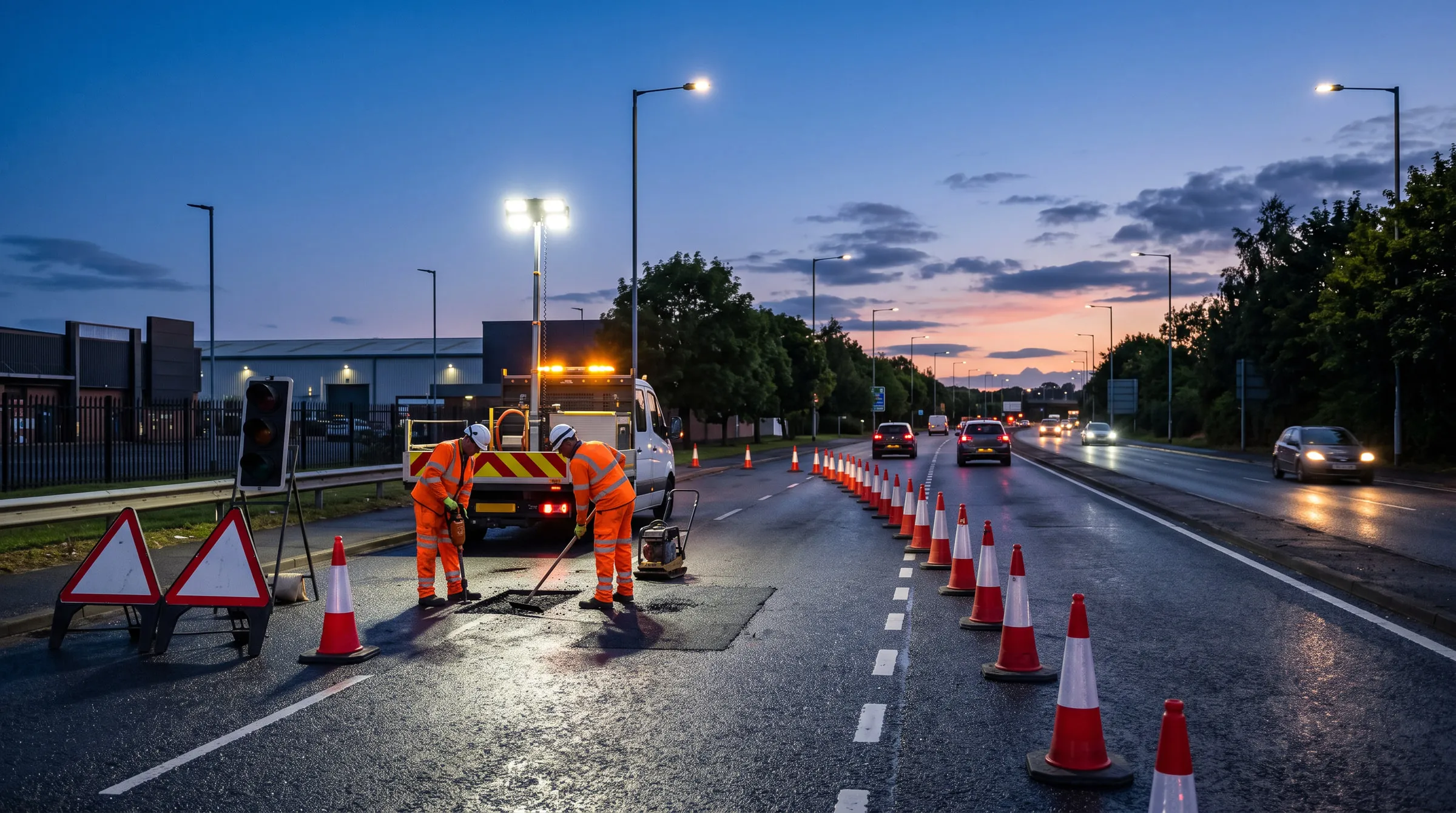
On some parts of the network, the productive constraint is traffic rather than daylight.

A defect on a busy arterial route may be straightforward to repair but difficult to access safely during the day. The same defect in an evening or off-peak window can be completed with less disruption and higher productivity, provided the working arrangements, lighting and traffic management are appropriate.

Working windows are therefore treated as a variable in programme design rather than a fixed assumption — always within permitted hours, noise constraints and the conditions attached to the relevant permits and approvals.

A highways maintenance crew working under mast-mounted task lighting during an evening maintenance window on a British commercial arterial road, with a long tapered cone closure and portable traffic signals.
Evening working window on a commercial arterial route, under full temporary traffic management.

Next step

Bring us a programme, not a job list.

The larger and more geographically defined the pool, the more there is to optimise. We are happy to talk through how a specific programme would be sequenced.